Backend Component
The Backend Component is the HTTP surface of your Aegis project. It is FastAPI underneath, but Aegis ships an app factory and three drop-in directories that turn the backend into a composition point for the rest of the stack: services register routes, infrastructure components register middleware, and the lifespan is owned by auto-discovered startup and shutdown hooks.
Musings: On Backend Choices (November 2025)
Most of my experience is with FastAPI, but I did have the chance to do some Flask work in a production environment this past summer, and it was rather fun.
Regarding using it as a backend, I mean, it's just another backend to learn, and if I can just deal with the sync/async stuff, it's something I can confidently say I wouldn't mind throwing in as an option.
Of course, with Flet as the frontend (though perhaps forced dependency goes away?), FastAPI will always be there as its own backend. But all API related stuff is handled in Flask... In theory...
What Aegis Adds On Top Of FastAPI
If you have used FastAPI before, you have written something like:
app = FastAPI()
app.add_middleware(CORSMiddleware, ...)
app.include_router(my_router)

@app.on_event("startup")
async def on_startup(): ...
Aegis splits that single call site into four:
| Concern | Where it lives | Discovery |
|---|---|---|
| App factory | app/components/backend/main.py |
Explicit |
| Middleware | app/components/backend/middleware/*.py |
Auto-discovered |
| Startup / shutdown | app/components/backend/startup/*.py, shutdown/*.py |
Auto-discovered |
| Routers | app/components/backend/api/routing.py |
Explicit |
The reasoning is asymmetric on purpose. Middleware and lifecycle hooks are infrastructure: components and services should be able to drop one in without editing a central file. Routers are the public surface of the application, so they stay in one explicit registry where you can see the whole API shape at a glance.
Request Flow
HTTP request
    |
    v
+---------------------------------------+
| Middleware stack (auto-discovered)    |
|   CORS                                |
|   SessionMiddleware  (if auth+oauth)  |
|   Logfire tracing    (if observ.)     |
|   ...your middleware...               |
+---------------------------------------+
    |
    v
+---------------------------------------+
| Router (explicit in api/routing.py)   |
|   /health, /api/v1/*, /events/*, ...  |
+---------------------------------------+
    |
    v
+---------------------------------------+
| Endpoint function -> service layer    |
+---------------------------------------+
The lifespan wraps this whole flow. On boot, startup_hook functions in
startup/*.py run in discovery order. On shutdown, shutdown_hook
functions in shutdown/*.py run in reverse order so resources unwind
in the opposite order they were acquired.
Anatomy Of app/components/backend/
app/components/backend/
├── main.py              # create_backend_app() + get_configured_app()
├── hooks.py             # BackendHooks: discovery + execution machinery
├── middleware/          # Auto-discovered middleware modules
├── startup/             # Auto-discovered startup hooks
├── shutdown/            # Auto-discovered shutdown hooks
└── api/
    ├── routing.py       # The single explicit router registry
    ├── health.py        # Health endpoints (always present)
    └── ...              # Service routers (auth, ai, payment, etc.)
create_backend_app(app) in main.py is the single entry point: it stashes
the configured app for later introspection, runs middleware discovery
against middleware/, and calls include_routers(app) from
api/routing.py. Lifespan hooks are wired separately so they run inside
FastAPI's lifespan context, not at import time.
Inspecting The Backend In Overseer
Open the Aegis dashboard and click the Backend card. The modal has three tabs that mirror the four concerns above:
- Overview: route count, endpoint count, middleware count, security layer count, plus host system metrics (CPU, memory, disk).
- Routes: every registered route, grouped by OpenAPI tag, with method badges, path parameters, response models, and dependency info. See Routes.
- Lifecycle: a flow diagram of startup hooks, middleware stack, and shutdown hooks, with an inspector panel for the selected item. See Lifecycle.
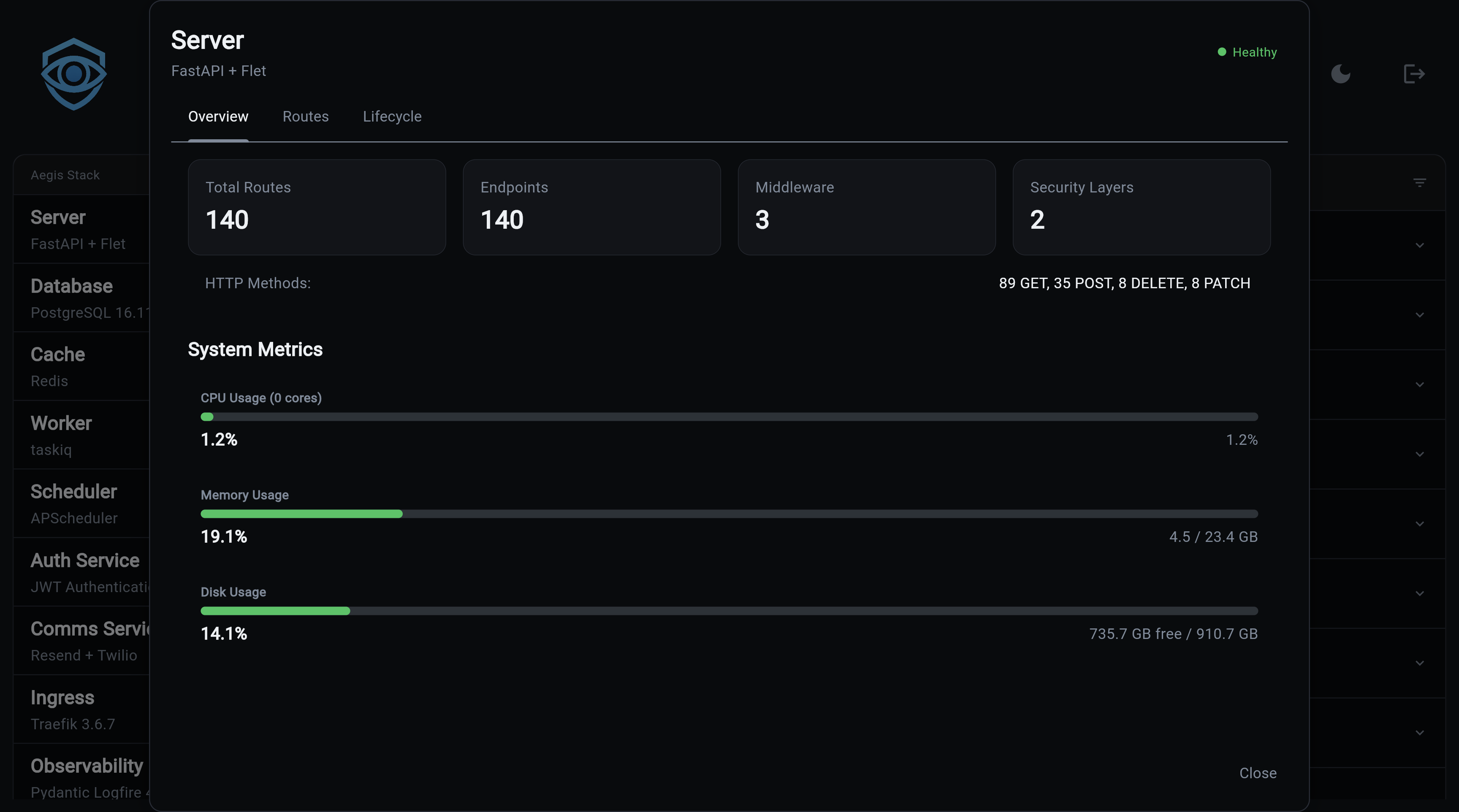
The dashboard pulls this data from cached metadata that the
component_health startup hook builds when the app boots. If you add a
new middleware or hook, restart the backend and it shows up automatically.
Next Steps
- Middleware: the auto-discovery contract, the middleware that ships in the templates, and how to add your own.
- Lifecycle: startup and shutdown hooks, ordering rules, and the Overseer Lifecycle tab.
- Routes: how routers are registered, what each conditional block maps to, and how to add one.
- Authentication Integration: how the auth service plugs into the backend through SessionMiddleware, rate limiting, and router registration.