Routes
Unlike middleware and lifecycle hooks,
routers in Aegis are explicitly registered. There is exactly one
place in the backend where every public route is wired up:
app/components/backend/api/routing.py.
That asymmetry is intentional. Middleware and hooks are infrastructure that services drop in; the public surface of the application should be visible in a single registry so you can audit it at a glance.
The Registry
include_routers(app) is called by create_backend_app() after
middleware discovery. The template version reads roughly:
# app/components/backend/api/routing.py
def include_routers(app: FastAPI) -> None:
    app.include_router(health.router, prefix="/health", tags=["health"])

    # Worker (if include_worker)
    app.include_router(worker.router, prefix="/api/v1")
    app.include_router(task_history.router, prefix="/api/v1")
    app.include_router(worker_events.router, prefix="/events", tags=["events"])

    # Scheduler (if scheduler_backend != "memory")
    app.include_router(scheduler.router, prefix="/api/v1")

    # Auth (if include_auth)
    app.include_router(auth_router, prefix="/api/v1")
    # OAuth (if include_oauth)
    app.include_router(oauth_router, prefix="/api/v1")
    # Orgs (if include_auth_org)
    app.include_router(org_router, prefix="/api/v1")

    # AI service routers (if include_ai)
    app.include_router(ai_router)
    app.include_router(voice_router, prefix="/api/v1")   # ai_voice
    app.include_router(llm_router, prefix="/api/v1")     # ai_backend != memory + ollama
    app.include_router(rag_router, prefix="/api/v1")     # ai_rag

    # Other service routers
    app.include_router(comms_router, prefix="/api/v1")   # include_comms
    app.include_router(insights_router, prefix="/api/v1")
    app.include_router(payment_router, prefix="/api/v1") # include_payment
    app.include_router(payment_pages_router)
    app.include_router(blog_router, prefix="/api/v1")    # include_blog

    # Plugin routers
    for router in plugin_routers:
        app.include_router(router, ...)
(The actual file is a Copier template; the if include_* gates are
Jinja conditionals, so a generated project only contains lines for the
services it enabled.)
A few conventions to notice:
/healthis always present. It carries no version prefix because the health surface is used by orchestrators (Docker, Kubernetes, Overseer) that should not have to know about API versions.- Versioned APIs live under
/api/v1. Every service-owned router mounts there. When the API contract changes incompatibly, the next router goes under/api/v2and lives alongside the old one until consumers migrate. - Tags are set at registration time when the inner router does not
set them. The auth, AI, payment, and similar routers bring their
own
tags=declarations because their internal grouping is more nuanced than a single top-level tag. - Worker events mount at
/events. Server-Sent Events are not a versioned REST surface.
Adding A Router
The pattern is the one already used by every service:
1. Define the router.
# app/components/backend/api/reports.py
from fastapi import APIRouter

from app.services.reports import generate_weekly_summary

router = APIRouter()

@router.get("/reports/weekly")
async def weekly() -> dict[str, object]:
    return await generate_weekly_summary()
2. Register it explicitly.
# app/components/backend/api/routing.py
from app.components.backend.api import reports

def include_routers(app: FastAPI) -> None:
    # ... existing registrations ...
    app.include_router(reports.router, prefix="/api/v1", tags=["reports"])
Restart the backend. The route appears in the OpenAPI schema at
/openapi.json, in Swagger at /docs, and in Overseer's Routes tab.
Inspecting Routes In Overseer
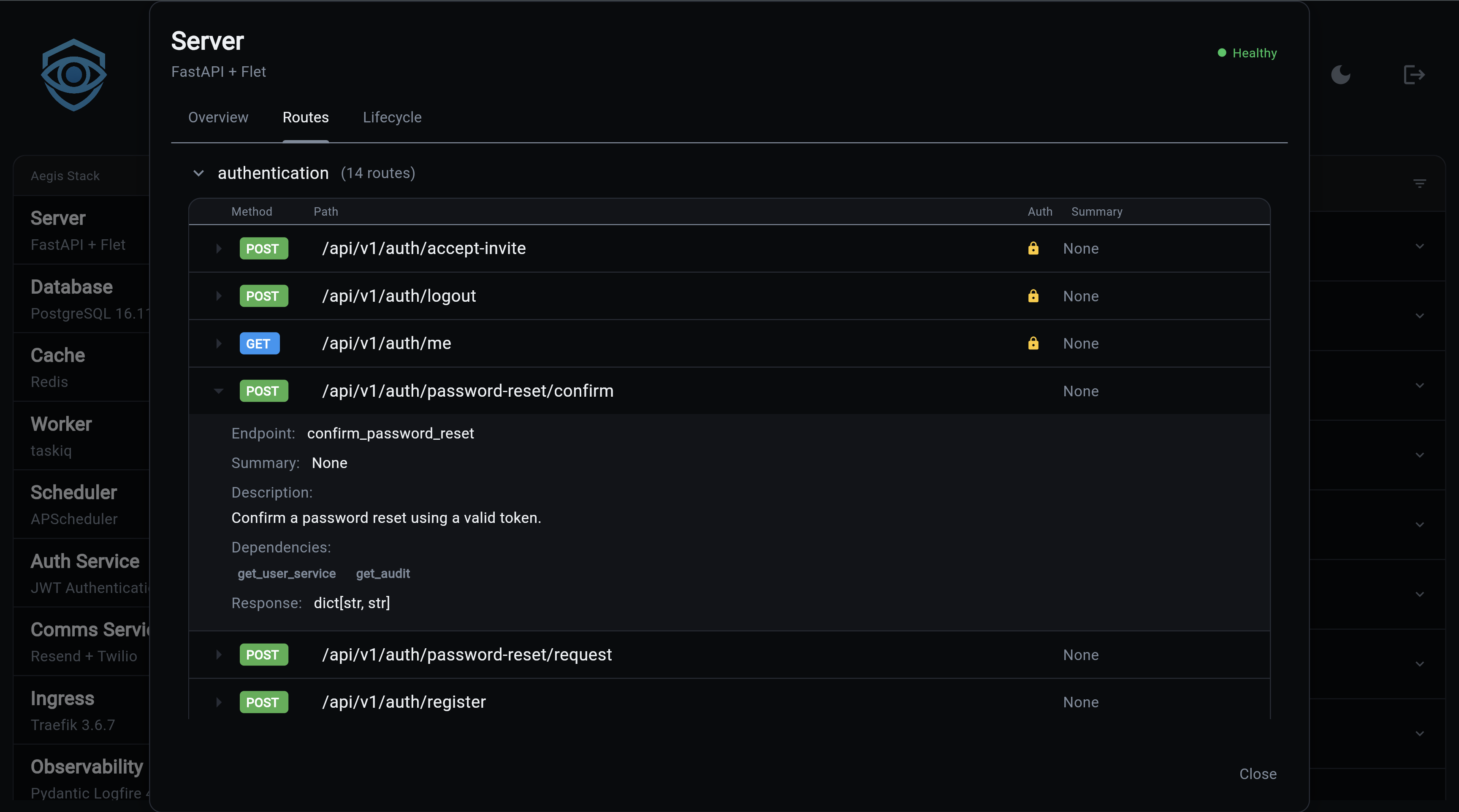
The Backend modal's Routes tab renders the full registered surface grouped by OpenAPI tag. Each route card shows:
- HTTP method badge (color-coded by method).
- Path with parameter slots highlighted.
- Response model name (if declared).
- Dependency chain (
Depends(...)callables that resolve before the endpoint runs). - A security badge when the endpoint requires authentication.
Because the Routes tab reads from cached metadata built by the
component_health startup hook, anything you add at runtime (rare, but
possible via the FastAPI app object) will not appear until the next
restart. Anything registered through include_routers shows up
automatically.
Standard Endpoints Provided By FastAPI
Aegis does not strip FastAPI's defaults:
/openapi.json: machine-readable schema./docs: Swagger UI./redoc: ReDoc UI.
These are excluded from Logfire's HTTP instrumentation along with
/health/* and /dashboard/*. See
middleware -> logfire_tracing.
Reference
app/components/backend/api/routing.py: the registry above.app/components/backend/api/health.py: the health endpoints, always present.app/components/backend/main.py:create_backend_appcallsinclude_routers(app)right after middleware discovery.- Service-owned routers live under
app/components/backend/api/<service>/for services that ship multiple sub-routers (auth, AI, payment, comms, blog, insights, orgs).