Lifecycle
The backend's lifespan is composed of startup hooks and shutdown
hooks, auto-discovered from
app/components/backend/startup/ and app/components/backend/shutdown/.
This is the place to open a database connection, register health checks,
spawn a supervised subprocess, or release any of the above on the way
out.
The Auto-Discovery Contract
app/components/backend/hooks.py walks both directories at startup,
imports every *.py module whose name does not begin with _, and binds
any module-level startup_hook callable into the lifespan. Same for
shutdown_hook in shutdown/.
# app/components/backend/startup/your_hook.py
from app.core.log import logger

async def startup_hook() -> None:
    """Description shows up in Overseer's Lifecycle inspector."""
    logger.info("Doing the thing...")
# app/components/backend/shutdown/your_hook.py
from app.core.log import logger

async def shutdown_hook() -> None:
    """Description shows up in Overseer's Lifecycle inspector."""
    logger.info("Releasing the thing...")
Important details:
- The function name is exact:
startup_hookorshutdown_hook. A module that does not export one of those is ignored. You can give the real implementation any name you want and assign it at the bottom of the module (startup_hook = my_real_function) — that is how the built-indatabase_init.pyandpayment_webhook_forwarder.pymodules are structured. - Sync or async, both are supported.
hooks.pyinspects the callable and awaits it when it is a coroutine function. - Startup runs in discovery order. Shutdown runs in reverse. That way a hook that depends on something a later startup hook produced will tear down before the producer does.
- Failures behave differently. A startup hook that raises stops the boot (the exception propagates out of the lifespan). A shutdown hook that raises is logged and the remaining shutdown hooks continue to run — you should never lose a cleanup because an earlier one blew up.
- The hook's docstring is what Overseer shows in its Lifecycle inspector. Write it as a description, not a free-form note.
Startup vs Middleware
If you find yourself reaching for a startup hook, sanity-check the choice against middleware:
| Concern | Use |
|---|---|
| Add an ASGI layer around every request | Middleware |
| Configure or instrument the FastAPI app object | Middleware |
| Open a resource, spawn a subprocess, populate a cache | Startup hook |
| Register a health check, scheduled job, or feature flag | Startup hook |
| Bind a route conditionally | Router registration (see Routes) |
Middleware registration is sync and happens at import time. Startup hooks run inside the event loop, so they are where you do anything async or anything that needs the database to be reachable.
Hooks That Ship In The Templates
The following modules live under app/components/backend/startup/ and
shutdown/ in a generated project, gated on the components and services
you enabled.
startup/component_health.py
Always present. Caches route metadata, middleware metadata, and
lifecycle metadata once at boot using introspection helpers from
app.services.backend.*_inspector. Then registers health check
callables for every component and service in the stack against
app.services.system.health. The cached metadata is what feeds
Overseer's Overview, Routes, and Lifecycle tabs — if you add a
middleware or router after boot, restart so this hook re-caches it.
startup/database_init.py (database only)
Always present when the database component is included. Behavior varies by engine:
- SQLite: creates the database directory, calls
SQLModel.metadata.create_all(engine), then runs a schema mismatch check that compares SQLModel metadata against the live schema and logs missing tables or columns. - Postgres without migrations: same
create_allflow. - Postgres with services that own migrations (auth, blog, insights,
payment, AI with non-memory backend): runs Alembic
upgrade headprogrammatically. Before running, it checks for stale revisions left behind by-fregenerations and for pre-existing tables left behind by persisted Docker volumes, stamping them as applied so migrations can converge.
Failures here re-raise. A backend that cannot reach its database has no business serving traffic.
startup/payment_webhook_forwarder.py (payment only)
Spawns stripe listen as a supervised subprocess when all of:
STRIPE_SECRET_KEYstarts withsk_test_.STRIPE_WEBHOOK_SECRETis empty.- The
stripeCLI is onPATH.
Captures the whsec_... signing secret stripe-cli prints on first
connection and injects it into the payment provider so a fresh project
with only STRIPE_SECRET_KEY set can receive end-to-end test webhooks
with zero extra configuration. Missing any of the three gates logs a
single line and no-ops; this hook must degrade silently in CI, Docker
without stripe-cli, and production.
shutdown/cleanup.py
Always present. Placeholder graceful-shutdown logger. Add code here for any teardown that does not have a dedicated module.
shutdown/payment_webhook_forwarder.py (payment only)
Pairs with the startup forwarder. Sends SIGTERM, waits up to 3 seconds, then escalates to SIGKILL. No-op when the startup gate didn't pass.
Authoring A Hook
A common pattern: open a resource on startup, close it on shutdown. The two modules share state via a module-level variable in the startup module that the shutdown module imports.
# app/components/backend/startup/cache_warmer.py
from app.core.log import logger

_warm_task = None

async def _warm_loop() -> None:
    # ... periodic warm-up work ...
    pass

async def startup_hook() -> None:
    """Spawn the background cache warmer."""
    global _warm_task
    import asyncio
    _warm_task = asyncio.create_task(_warm_loop())
    logger.info("Cache warmer started")
# app/components/backend/shutdown/cache_warmer.py
from app.components.backend.startup import cache_warmer as _warmer
from app.core.log import logger

async def shutdown_hook() -> None:
    """Cancel the background cache warmer."""
    task = _warmer._warm_task
    if task is not None:
        task.cancel()
        logger.info("Cache warmer stopped")
Restart the backend and both hooks show up in Overseer's Lifecycle tab, with their docstrings as descriptions.
Inspecting Lifecycle In Overseer
The Backend modal's Lifecycle tab renders the boot pipeline as three lanes:
Each lane shows a card per registered item with its name and module path. Clicking a card opens the inspector on the right with the full docstring and any extra metadata the introspector exposed. Middleware cards additionally show a security badge for layers that participate in auth (SessionMiddleware, anything tagged as security in the route metadata).
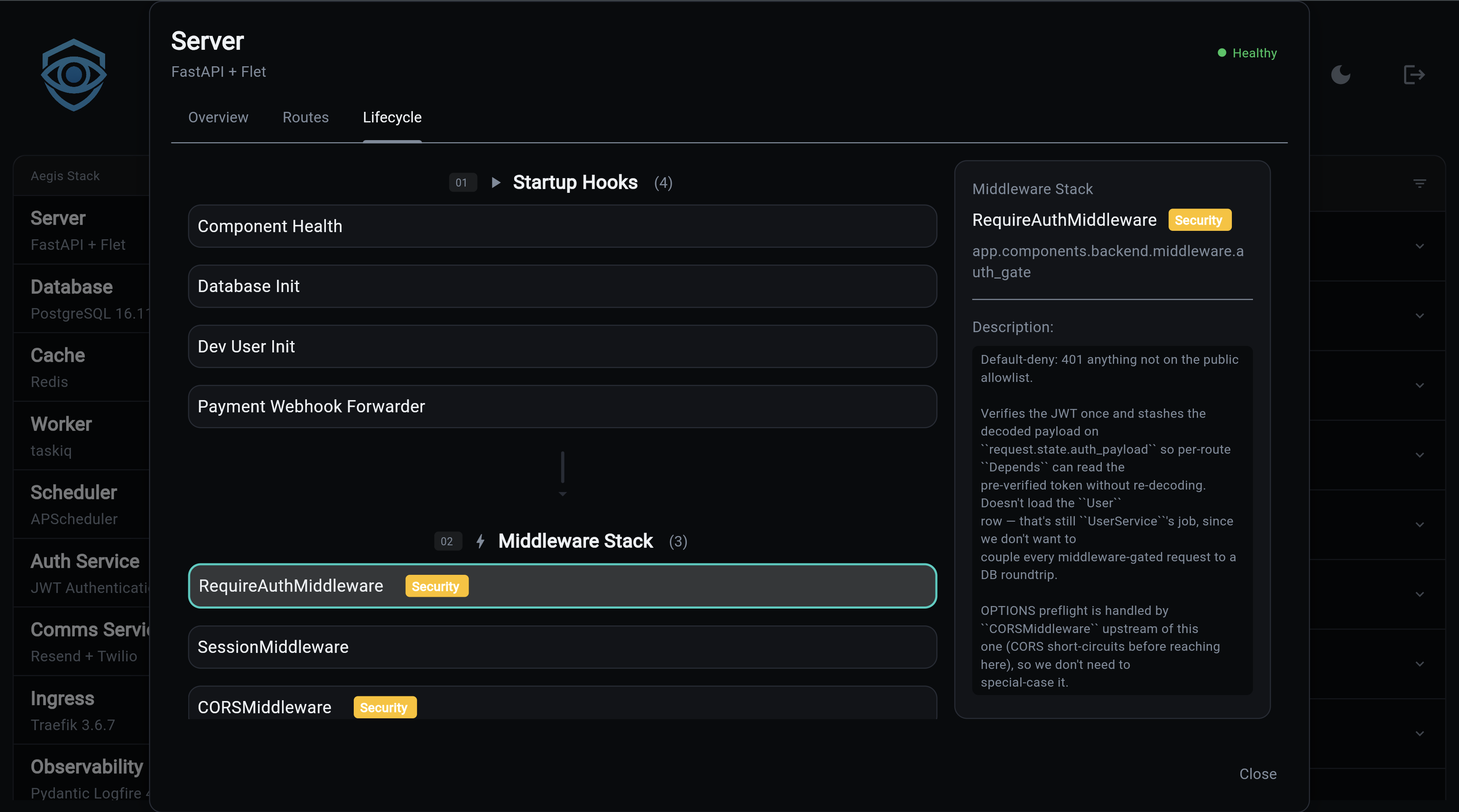
If a hook you added is not visible, three things to check:
- The function is named exactly
startup_hookorshutdown_hook. - The filename does not start with
_. - The backend was restarted after the file was created — the cache is built once at boot.
Reference
app/components/backend/hooks.py: discovery and execution (_discover_startup_hooks,_discover_shutdown_hooks,execute_startup_hooks,execute_shutdown_hooks).app/components/backend/startup/component_health.py: where the Lifecycle tab metadata originates.- Middleware: for sync, request-path concerns.
- Routes: for endpoint registration.